
“Jjimjilbang” can describe a neighbourhood sauna, a large shared rest complex, or one zone inside a premium spa and water-park destination. That is why two first-time visitors can follow equally confident online advice and arrive at completely different places. Start by identifying the venue type, then learn the building’s own sequence instead of treating one viral checklist as a national rule.
First identify what the listing means by jjimjilbang
A premium jjimjil spa can be a family leisure destination rather than a bare-bones bathhouse. Korea Tourism Organization’s current Aquafield Goyang record describes a jjimjilbang and spa complex with charcoal, red-clay, and bulgama rooms alongside media-art and cloud-themed rooms, plus a separate water-park offer. That one listing already shows why “sauna” is too narrow a translation: the visit can include heat rooms, pools, visual attractions, food, and long stretches of shared floor time.
A city facility can follow a different access model. VisitKorea lists Spa Lei in Seoul as women-only and notes a gown rental in the listed admission. Termeden in Icheon is described as a forest-side German-style spa resort with a water park, bade pool, hot-spring spa, sports and other facilities. Neither record should be treated as the template for every jjimjilbang; together they show that audience, dress, water facilities, scale, and purpose can change before you reach the locker.
The operator’s own Aquafield Goyang page separates its Jjimjil Spa, sauna, rooftop pool, food court, operating policy, payment settlement, rental information, and visit sequence. That structure is more useful than a generic packing list: open the specific venue’s live page to verify which zones, rules, and services belong to the ticket you are considering. A tourism listing can orient you; the operator page is where a facility explains its current moving parts.
Read the venue name and current official page before reading a general etiquette guide. Is the ticket for a sauna, a jjimjil spa, a water park, or a combined pass? Is the whole facility restricted by gender, or only some areas? Are children admitted? Is the shared rest zone included? A five-minute venue check prevents the most common category mistake: arriving ready for a quiet city bath when the booking is for a resort, or expecting a mixed social lounge at a facility whose published audience is women only.
Read the building as two zones, then confirm the exceptions
Many first-time guides become clearer when you separate bathing from the clothed common area. The bath and changing zone commonly has stricter privacy rules; the shared jjimjil zone is where the facility uniform, heated rooms, snack counter, mats, and group rest are more likely to appear. Do not assume that every ticket includes both zones or that every venue uses the same gender arrangement. The desk, ticket page, and signs at the transition point outrank a video filmed somewhere else.
At check-in, ask for a simple route rather than a complete cultural lesson: “Locker, bath, then common area?” A 2024 Korea Tourism Organization visitor guide describes personal lockers, a key commonly worn on the wrist or ankle, access to paid amenities, and settling extras when the key is returned. The same guide warns that details can change, so use that sequence as orientation and confirm the actual key, clothing, payment, and checkout system at your venue.
Seoul’s official tourism listing for Spa Lei, edited in July 2026, identifies it as women-only and lists a 24-hour schedule. This is not a reason to assume every bathhouse works that way. It is a clean example of the checks that should happen before a visit: audience, hours, and the venue’s own contact route.
The unclothed bath is the part that makes some visitors hesitate. You do not need to pretend that the feeling is universal. If the venue requires bathing before entry to another area, ask what the minimum sequence is. If a space, dress rule, or level of exposure does not work for you, skip that venue or that zone. A first visit succeeds when you understand the boundary and make a comfortable choice, not when you complete every activity.

CHOOSE YOUR NEXT QUESTION
Continue through the issue
Three questions that change a first visit
1. Can a couple or family use the parts we want together? Treat the unclothed bathing area and the clothed heat-and-rest area as separate questions. Aquafield’s official structure distinguishes jjimjil-spa, sauna, pool, food, and other facilities, while Spa Lei’s Seoul record is women-only. Ask the specific venue which zones are included for your ticket, who may enter each one, and what children or companions need to know. This guide does not rank venues or promise entry for a couple, family, or any other group.
2. Does “24 hours” mean you can stay overnight? No general answer is safe. Visit Seoul’s Spa Lei record lists a 24-hour schedule, and the Korea Tourism Organization’s first-visit guide warns that operating details can change. Ask the venue directly about overnight stays, last admission, sleeping areas, re-entry, luggage, checkout, and any age or group rule. A 24-hour line is not an overnight guarantee, and this guide does not quote a live price or ticket condition.
3. What should a first-time foreign visitor confirm before arriving? Start with the official page and ask for the venue’s own locker, bath, clothing, payment, and common-area sequence. The Korea Tourism Organization visitor guide describes a common locker-and-wrist-key orientation, but not a universal facility rule. It does not establish English support, admission, a particular price, or an overnight outcome for your visit; staff and current signs control those details.
Check six live details before leaving your hotel
Hours and prices are live operational data, not permanent cultural facts. The Aquafield record publishes separate water-park and jjimjil-spa hours and notes seasonal variation for part of the operation. Spa Lei’s VisitKorea record lists 24-hour operation, while Termeden’s record explicitly directs readers to its official site because hours and ticket prices vary by day and facility. Recheck on the day of travel even when a tourism listing still appears current.
Confirm the six details that change the visit: current hours, last admission, ticket inclusions, gender or age restrictions, overnight or luggage policy, and whether the venue accepts your planned payment method. Add tattoo rules, accessibility, and child supervision when they apply to you. Write the questions in a translation app before arrival rather than relying on a long conversation at a busy reception desk.
Do not interpret “open 24 hours” as permission to sleep overnight, store large luggage, or enter every area at any time. Those are separate policies. The same caution applies to towels, toiletries, uniforms, and food: some are included, some are rented, and some are purchased after entry. A specific venue can answer these questions; a nationwide guide cannot do so honestly.
Use a deliberately small first-visit sequence
Step one is orientation: locate the shoe locker if there is one, the main locker, the bath entrance, and the route to the clothed common area. Step two is one basic activity: shower or bathe according to the venue rule, or go directly to the included shared zone if the facility allows it. Step three is rest. Choose one warm room or one lounge seat, then decide whether you want food, another room, or checkout.
Bring only what reduces friction: a change of underwear, a hair tie, personal after-shower items, and a small bag for wet belongings. Keep your phone and camera out of bath and changing spaces. In the common area, look for posted photography rules before taking any picture and never include strangers. A visually interesting room is still a shared leisure space, not a content set.
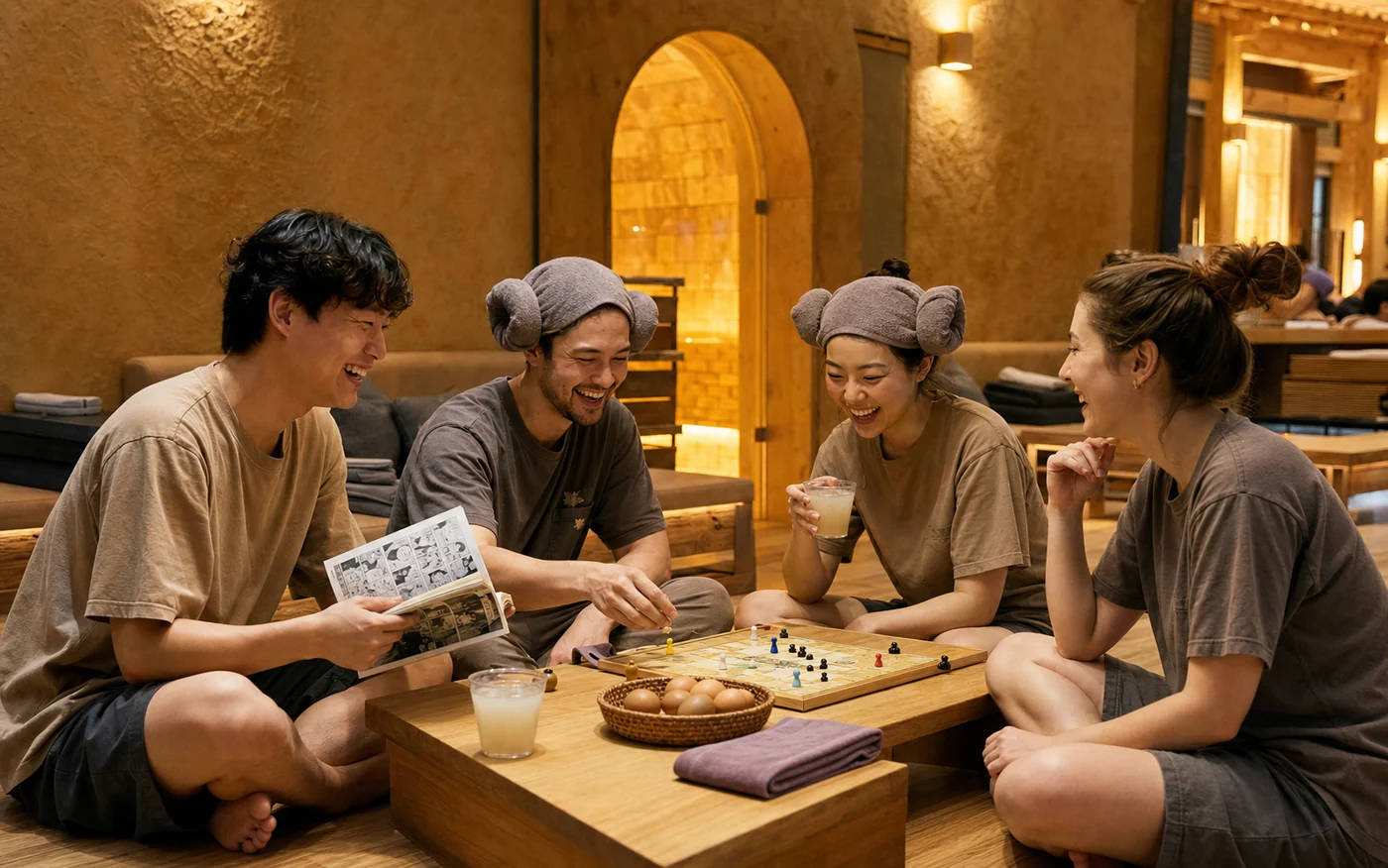
You can skip the hottest room, the cold bath, a scrub service, the sheep-head towel, sikhye, eggs, sleeping, and every other item that appears in “must-do” videos. Those are possible parts of the culture, not a completion card. If you want a body scrub, check the separate Seshin guide before deciding; the service has its own privacy, pressure, communication, and stop-right questions.
JJIMJILBANG FIELD CARD · YANGMEORI
How to fold a yangmeori (sheep-head) towel
Yangmeori—literally “sheep head”—is a playful towel fold often seen in jjimjilbang scenes. It is optional, not a venue rule or an etiquette test.
Make one long band
Lay a small, dry hand towel flat. Fold one long edge toward the centre, then fold the opposite long edge over it to make a narrow band.
Roll the first end
Turn one short end back over itself like a cuff. Repeat two or three times, rolling toward the centre without pulling the towel tight.
Match the other end
Repeat at the other short end. Stop when the unrolled middle is wide enough to rest comfortably across the top of your head.
Open, place, and loosen
Gently open only the unrolled middle into a shallow pocket. Place it over your head with one rolled end above each ear.
Etiquette is mostly about reducing work for everyone else
Wash where the venue asks guests to wash, keep personal products contained, and follow the sign rather than copying one person from a distance. Return borrowed items to the indicated place. Do not reserve a mat, heated-room seat, or table with a spread of belongings when the facility is busy. Keep calls and videos quiet in rest areas and use headphones when the venue allows devices.
The most useful reception questions are concrete: “Is this area mixed-gender?”, “Where do I wear the uniform?”, “Are photos prohibited here?”, and “How do I pay for food?” A staff answer resolves that uncertainty faster than watching several tour videos. If the answer is unclear, take the more private option: put the phone away, keep the uniform on in shared zones, and wait for a sign or staff direction.
Public leisure works because strangers leave room for one another. That means no commentary on other bodies, no filming reactions to nudity, and no treating ordinary guests as background characters in a Korea experience. Curiosity belongs in the architecture, food, signs, and your own choices. Other guests are not exhibits.
End the visit by closing the payment and privacy loop
Before checkout, collect items from every locker, separate wet belongings, return clothing or towels where instructed, and check whether the wrist key holds purchases. Ask about any charge you do not understand before handing over the key. If the venue uses a shoe-locker token or receipt, keep it until you have your shoes and luggage back.
Do not post a changing-room mirror photo later simply because nobody objected while you took it. Review the frame for faces, locker numbers, receipts, wrist-key numbers, and other identifying details. A photo that is harmless as a private travel record can become intrusive when published. The safest memory from a bathhouse may be a picture of the exterior sign or your snack in an explicitly permitted common area.
After one modest visit, you will know which question matters for the next one: more private, more social, more traditional heat rooms, a water park, a women-only venue, a body scrub, or simply a longer rest. That is a better outcome than declaring that you have “done” jjimjilbang culture. The format is broad, and the next venue may still work differently.
ISSUE COMPANION
Three listings that show three different venue types
Use these official examples to identify the kind of place you are considering. They are not rankings, and all operational details require a same-day check.
| Aquafield Goyang | Premium family-oriented jjimjil spa with traditional and themed heat rooms, alongside a separate water-park offer.Check which ticket and zones your booking includes. |
|---|---|
| Spa Lei, Seoul | A women-only city jjimjilbang listing with gown rental noted in the published admission information.Confirm the current audience, hours, inclusions, and entry policy directly. |
| Termeden, Icheon | A forest-side spa resort and water-park format with a bade pool, hot-spring spa, and other leisure facilities.The official listing says hours and prices vary by day and facility. |
| Any other venue | Identify audience, included zones, live hours, last admission, dress, payment, luggage, child, tattoo, and overnight rules.The venue’s current page and signs outrank a general guide. |
BROWSER-ONLY · FIRST-VISIT FORMAT CHECK
Jjimjilbang First-Visit Format Check
Choose fixed planning categories before relying on a ticket or a video. No venue name, date, booking number, payment detail, identity detail, health detail, or photo belongs here. Selections stay in this browser tab.
60-SECOND ANSWER
A jjimjilbang is not one standard ticket or one standard zone.
An exact venue may combine gender-separated bathing, clothed shared heat rooms, a water park, or a larger spa-resort. Confirm the current ticket, included zones, audience rules, clothing boundary, and visit-day hours from the operator before payment.
Official records checked 2026-08-01. Recheck the exact facility before travelling.
OFFICIAL RECORDS
Recheck the records behind the categories
These records set the checker's limited scope. A venue's exact conditions can change after the editorial check.
- Korea Tourism OrganizationAquafield Goyang: jjimjil spa, water-park, and multipass formats
- Korea Tourism OrganizationSpa Lei: women-only city jjimjilbang record
- Korea Tourism OrganizationTermeden: spa-resort and water-park format
- Korea Tourism OrganizationFirst-visit jjimjilbang orientation guide
- Aquafield GoyangOperator facilities and current operation guide
- Visit SeoulSpa Lei audience and operating-information record